Overview
Case-Study Walkthrough
Project
Emerging AI tools are unlocking new workflows that enhance creative output and expand a designer’s ability to prototype and test product concepts.
In this project, I integrated several generative AI tools with traditional human-centered design methods to produce an interactive prototype grounded in UX research.
Impact
By blending AI with proven design practices, we can build MVPs to test ideas and gather meaningful user feedback in a fraction of the time required by traditional design sprints.
Outcome by Numbers
Hours Spent
16
Screens Generated
65
Sources Scraped
26
AI Usability Tests Completed
2
User Flows Prototyped
10
AI Tools Used
8
Product Vision
HypeLens is an AI-powered trend discovery and idea-generation tool designed for solo and small-team e-commerce merchants.
Its goal is to help creators and entrepreneurs quickly spot relevant cultural trends, validate their potential, and generate actionable, brand-aligned ideas.


Problem Space
E-Commerce Creators can make a lot of money and push a lot of product if they know what trends to act on.
Reversely, they can lose a lot of money and risk damage to their brand reputation if they act on the wrong trend.
HypeLens helps creators cut through the noise by streamlining trend discovery, validation, and idea generation into one intuitive workflow.
Design Process
My High-Level AI Workflow

Phase
AI Tools Used
Outcome
1. Ideation & Concepting
ChatGPT-4o
Creative idea generation using Remix Theory
2. Research & Validation
ChatGPT Deep Research, ChatGPT-4o
Problem space analysis, competitive landscape, early trend signals
3. Persona & Journey Mapping
ChatGPT-4o
Detailed persona and As-Is journey map
4. Insight Generation (AI Interviews)
ChatGPT-4o, Claude AI
Simulated interviews revealing pain points, behaviors, goals
5. Feature Ideation
ChatGPT-4o, Claude AI
Structured feature set, impact/feasibility matrix
6. Product Definition
ChatGPT-4o
Epics, User Stories, UX flows, and full PRD
7. Wireframing & Exploration
Loveable, V0, Replit, UX Pilot
Early divergent wireframes across multiple models
8. Refinement
Figma, UX Pilot
Final curated wireframes aligned with brand and product vision
9. Branding
ChatGPT-4o, Adobe Illustrator
Logo exploration and final vector logo
10. Prototyping
Loveable
Clickable prototype
11. Usability Testing
ChatGPT-4o, Claude AI
Persona-driven feedback and UX improvements
Research
26 Sources Scraped

Key Findings
1. Trend Discovery is Fragmented
Merchants monitor multiple platforms (TikTok, Instagram, Reddit, Google Trends, Pinterest, etc.) but lack a centralized system to aggregate and filter trend insights.
2. Risk & Uncertainty Are Major Pain Points
Merchants struggle to distinguish between short-lived fads and sustainable trends. Poor timing or misreading a trend can result in unsold inventory or wasted campaigns.
3. Validation Requires Data Triangulation
After spotting a trend, merchants often cross-check Google Trends, competitor behavior, and customer comments to validate if it’s worth pursuing.
4. No Systematic Workflow
Most merchants rely on informal, intuition-based processes for tracking and validating trends, without automation or structured workflows.
5. Desire for Smarter Tools
There's strong demand for an affordable, integrated tool that surfaces relevant trends and offers actionable insights specific to a merchant’s niche, audience, and capabilities.
6. Trend Shelf-Life is Shrinking
Acting too slow often results in missed opportunities. But moving too fast without validation can lead to costly mistakes. Merchants are looking for a way to move fast and smart.
Target Persona

Quotes from Research
As-Is Journey Map
Stage | Actions | Thoughts & Feelings | Tools Used | Pain Points |
|---|---|---|---|---|
1. Trend Hunting | - Scrolls TikTok/Instagram/Pinterest | "Is this even real or just viral noise?" | TikTok, Instagram, Pinterest, Reddit, Google Trends, Notes app | 😵♀️ Info overload |
2. Trend Curation | - Collects screenshots, saves links | "I think I’m seeing something here... maybe ‘rituals’ or ‘glow-up kits’ are trending?" | Notion, Google Docs, camera roll | 📂 Disorganized |
3. Gut Check / Validation | - Asks herself “Is this on-brand?” | "I feel like it fits, but I'm not sure it’ll sell..." | Instagram Stories, Shopify analytics, Google Trends, DMs | 🎭 Fear of inauthenticity |
4. Brainstorming Ideas | - Thinks of product or content ideas tied to trend | "What’s a low-risk way to test this?" | Notes, Canva, AliExpress, Printful | 🏗 Difficulty going from idea to plan |
5. Execution | - Designs product | "Hope this hits... I’m winging it again." | Shopify, Canva, Klaviyo, Instagram, Google Sheets | ⚙ Fractured tools |
6. Post-Mortem / Learning | - Looks at sales + engagement | "Was it the trend or the timing or the copy?" | Shopify analytics, Klaviyo, social insights | ❓Unclear what worked |
Define
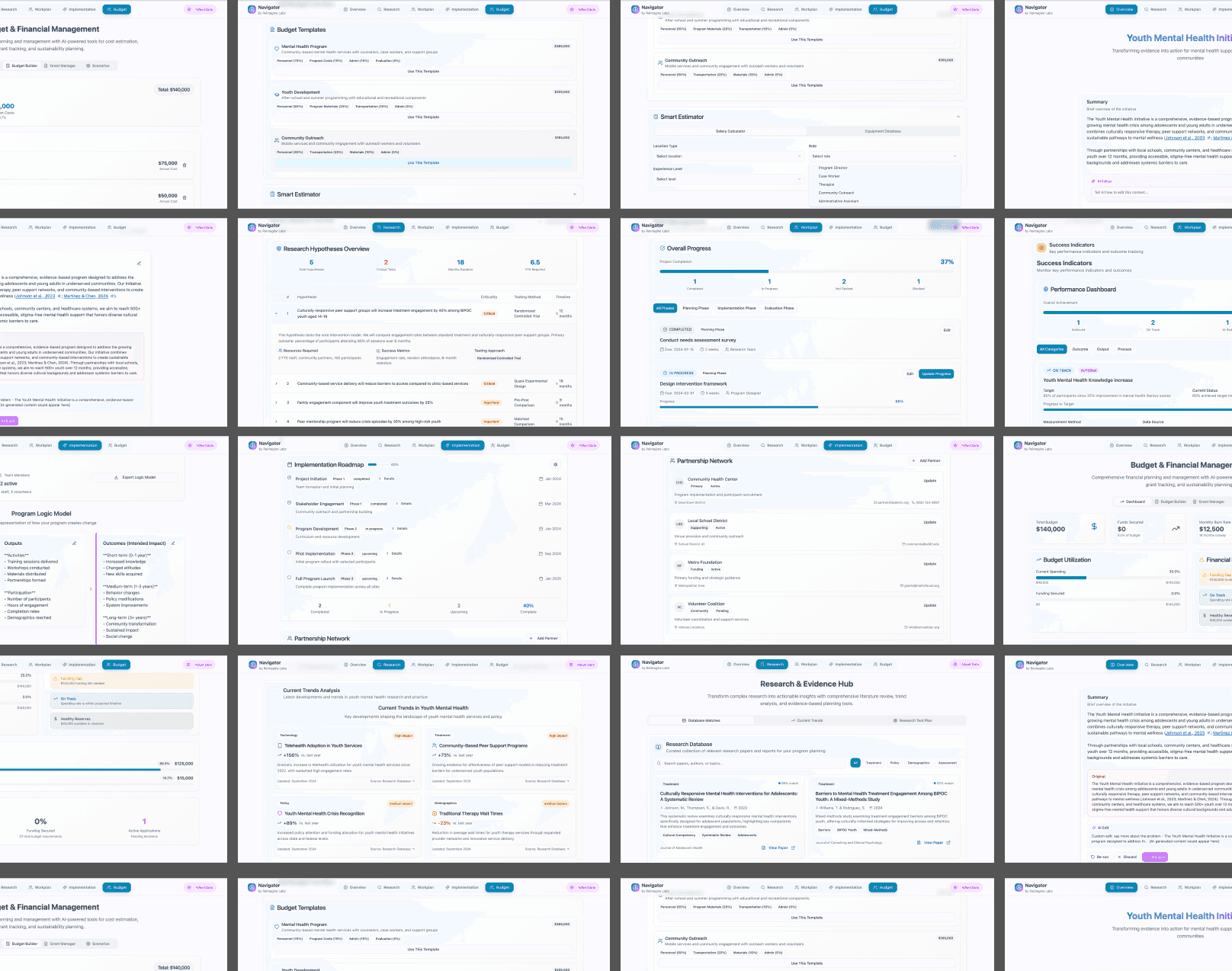
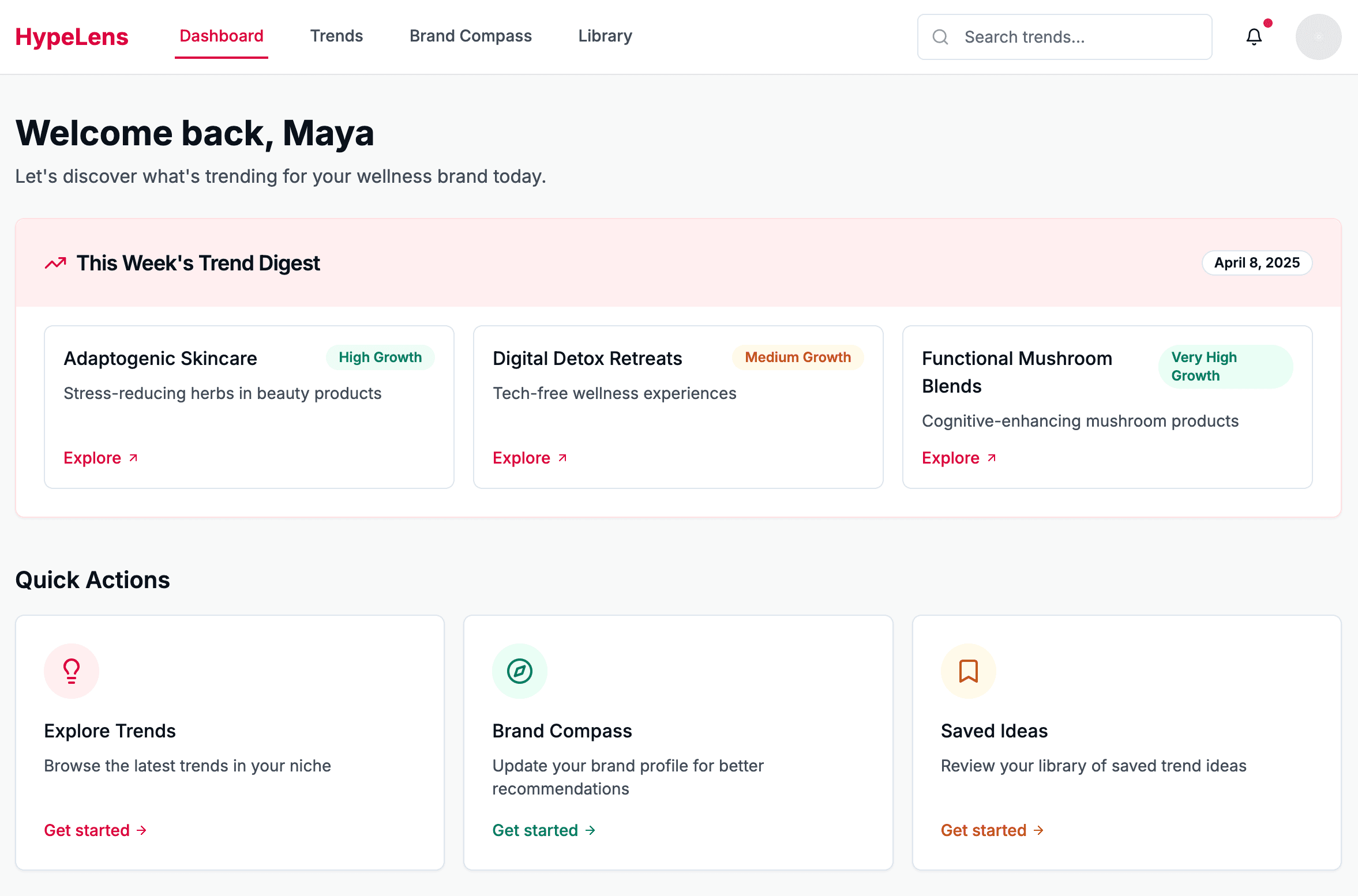
Wireframe Exploration




Design
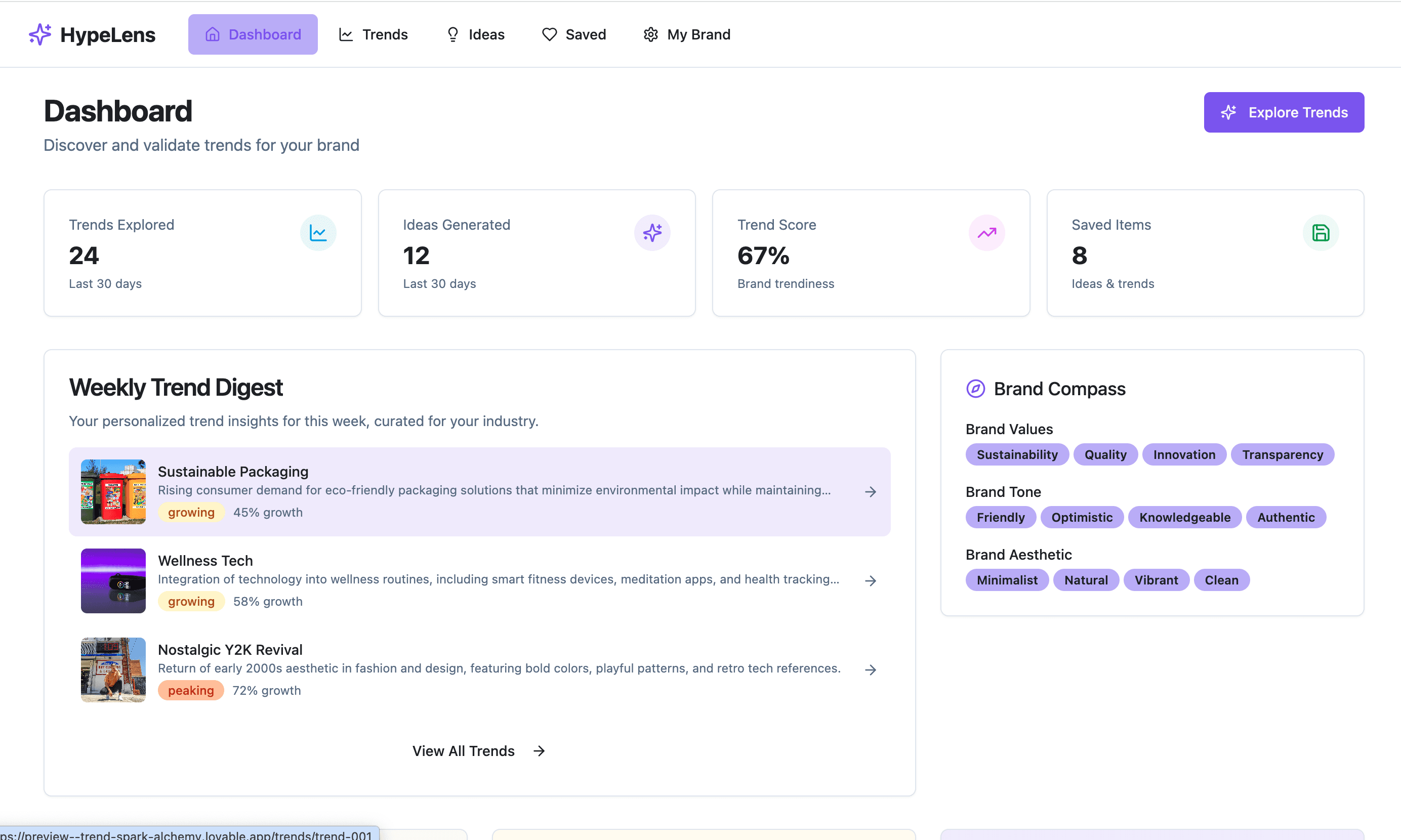
Final Prototype
Problem
How HypeLens Solves It
Struggle to identify emerging trends relevant to their niche
Curated Trend Feed with niche-specific filters and real-time cultural signals
Problem
How HypeLens Solves It
No simple way to identify trends rising across social media
Analytics Dashboard provides the insights creators need to make confident, informed decisions
Problem
How HypeLens Solves It
Risk of straying from brand identity when chasing trends
Brand Compass ensures all suggestions match the user’s tone, values, and aesthetic

Problem
How HypeLens Solves It
Unsure if a trend aligns with their brand and audience
Trend Validator with AI-powered scoring for Brand Fit, Audience Relevance, and Demand
Problem
How HypeLens Solves It
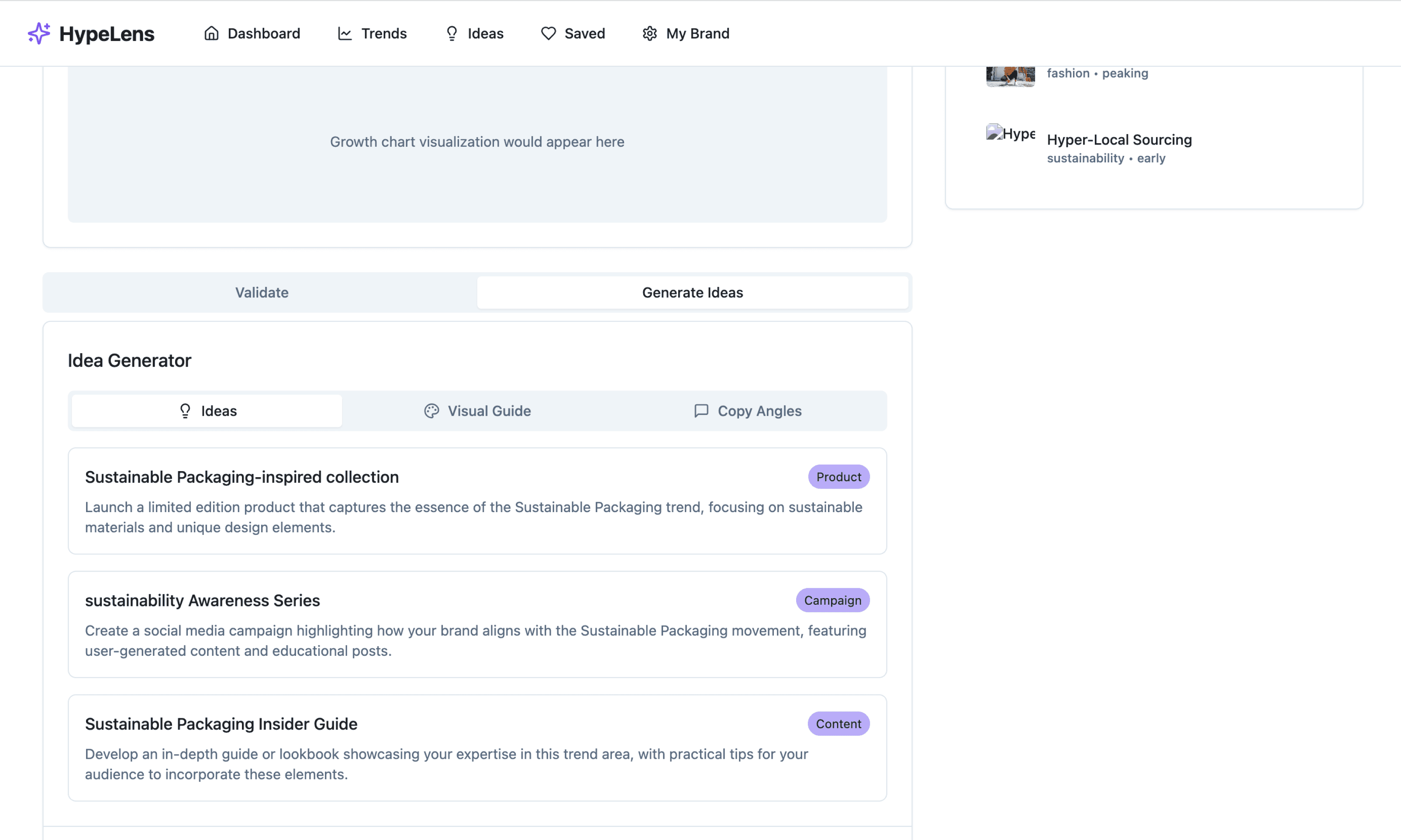
Difficulty turning trends into actionable product or content ideas
Ideas Lab generates on-brand product, campaign and content ideas instantly
Final thoughts
Exploring design concepts has never been easier. Although this is not fully functional, its enough to get in front of users/ stakeholders for validation and feedback on what to iterate on before developing.